

Table of contents
Picking a business phone system can be a real pain. The telecoms market is crowded with providers, resellers, and sub-resellers. They all offer products that sound similar at almost similar prices. Most small business owners have no easy way to compare them properly.
So most of the time, buyers go with a name they heard from someone in their industry, or whoever called first and seemed credible.
That is a reasonable response to a confusing market. The problem is that the industry rewards aggressive selling. The gap between a quoted monthly fee and the real cost of a contract can be enormous. Most owners don’t find out until they are already locked in.
We asked business owners in the UK and US about their experiences. The same pattern came back every time. Low quoted costs, long hidden contract terms, and exit penalties that make leaving nearly impossible.
The scale of the problem
A 2025 BBC investigation spoke to more than 160 small businesses trapped in expensive phone equipment agreements. The most striking case involved a business owner facing a bill of £54,432 over ten years for just five phones, with a £24,000 exit penalty.
Independent experts said the fees were much higher than they should be, and the contract was set up to benefit the provider, not the customer.
How do these deals work?
The sales pitch focuses on a short contract and a low monthly figure. Often, the service contract is described as two years.
What is not mentioned is that the hardware is funded through a separate finance agreement with a third-party leasing company. That agreement can run for 60, 72 or even 84 months.
The Promise
- Short-term commitment (often presented as a 2-year contract)
- Low monthly cost
- Attractive introductory offers (cashback or rebates)
The Reality
- Hardware financed separately through a third-party lease
- Lease terms can extend to 60, 72, or even 84 months
- Introductory incentives often funded by inflated lease costs
- The true cost only becomes visible after the initial period ends
Some customers get cashback or rebates for the first year or two. Legal specialists say that money typically comes from the inflated cost of the lease itself. It is your own money returned early to make the deal look attractive. When the introductory period ends, the real cost appears.
This UK case shows exactly how this plays out. A new owner, who bought a hair salon, discovered the previous owner had been signed into a 7-year agreement with a well-known UK service provider.
The equipment lease alone totalled £22,174.80 for four phones. When the new owner tried to exit, the combined termination fees across all three agreements came to over £10,500.
The monthly payment trap
We asked business owners to share their experiences. The story goes pretty much the same.
Ruben Medina, Head of Marketing and Sales at Koalendar, described what happened to his US team in 2023.

Ruben Medina
Head of Marketing and Sales, Koalendar

A reseller promised '$89/month per line'...
A reseller promised '$89/month per line' for a cloud solution with desk phones for our five-person team. What we didn't know was that it was a 60-month lease. The reseller avoided telling us the total cost of the contract, focusing instead on monthly costs and assuring us that the promotion price would expire on Friday.
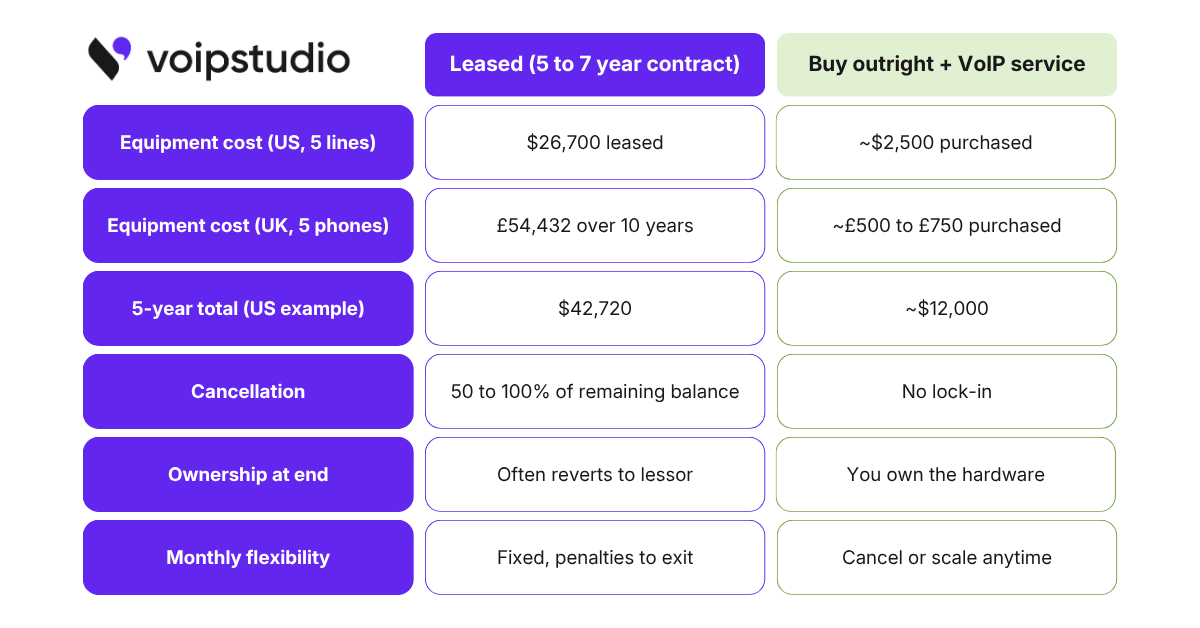
Ruben’s team signed for five lines at $445 per month. Total contract value: $26,700. The same equipment bought outright would have cost $2,500. They later added three more lines, bringing total committed spend to $42,720. The buy-plus-VoIP alternative would have cost around $12,000 over five years. The difference was $30,000.
Patricia Curts, Managing Director of The Mexican Collection in the UK, had a near-identical experience.

Patricia Curts
Managing Director, The Mexican Collection
The salesman had quoted me £35 a month which seemed reasonable enough but then I actually read the contract.
Buried inside was a five-year term, getting our total past £2,100 for equipment that would cost about £400 to buy outright. The pressure to sign fast was real, and those details are buried precisely because they're meant to be missed.
Leasing vs buying: Cost comparison
Here is what the numbers look like across two scenarios, based on real cases.
What happens when you try to exit
Chris Roy, Product and Marketing Director at Reclaim247, explains why the pattern keeps repeating.

Chris Roy
Product and Marketing Director, Reclaim247
These deals still happen because of how the sales funnel is designed.
They're laser-focused on conversion, signing up fast and anchoring decisions around monthly prices instead of total value.
In the US, equipment leases often require 50 to 75 percent of the remaining contract value on early exit. In the UK, the BBC found some contracts required 100 percent.
Roy puts it plainly: businesses end up stuck paying fixed costs for equipment they no longer need, with less money left to operate and react.
Why are small businesses easy targets?
Large companies have procurement teams and legal advisers. Small businesses usually have one person making the decision under time pressure. That is exactly what these sales tactics rely on.

Patricia Curts
Managing Director, The Mexican Collection

We're time-poor and usually the only person in the room...
Small businesses become the target because we're time-poor and usually the only person in the room. Most owners don't realise the real cost until months in, by which point they're already locked in.
Tom Terronez, CEO of Medix Dental IT, manages IT for dental practices across the US and sees it regularly.

Tom Terronez
CEO, Medix Dental IT
Get every extra charge written down before you sign anything...
Salespeople rushed us through new features but skipped the fee details. Then the recurring charges and maintenance costs piled up. Get every extra charge written down before you sign anything.
Six warning signs before you sign
- The salesperson only discusses the monthly cost and avoids the total contract value.
- There is deadline pressure. A promotion expiring Friday. A limited offer.
- The service contract is two years, but there is a separate equipment finance document with a longer term.
- A third-party finance company appears in the paperwork.
- Introductory cashback or rebates for the first year or two, with payments increasing after.
- Early termination requires payment of a large share of the remaining balance, sometimes 100 percent.
Three questions to ask before you sign
- What is the total contract value over the full term?
- What are the cancellation terms and early exit costs?
- Who owns the equipment at the end? Is there a separate finance agreement?
VoIP solution for businesses
All of the problems in this article come from the same place. A pricing structure built to hide the real cost. That is not a feature of business phone systems in general. It is a feature of hardware leasing models.
With VoIPstudio, there is no hardware to finance and no leasing company involved. The service runs on devices your team already owns. There is no separate finance agreement in the small print. Pricing is monthly with no long-term contract. Add users when you grow, cancel when you need to. Every new customer gets a 30-day free trial.
Call recording, voicemail to email, IVR menus, and CRM integrations with Salesforce, HubSpot, Zoho and other popular CRMs are all included as standard.
Tashlien Nunn, CEO of Apps Plus, put it simply after her own experience with a leasing deal.

Tashlien Nunn
CEO of Apps Plus
Run the math yourself.
Compare buying versus financing and get every cost in writing. Don't just take their word for the total price.
How to avoid getting locked in
The phone on your desk is not an expensive item. The cost in most of these cases came from the contract attached to it. The 60 to 84-month term. The fees that jumped after an introductory period. The separate finance company buried in the paperwork.
Just make sure you understand the total cost before you commit to anything.

Patricia Curts
Managing Director, The Mexican Collection

Being locked into years of payments for something you could have bought outright for a fraction of the cost is the part that lingers longest.
Contributors
Quotes in this article were ontained directly from small business owners. Contributors: Patricia Curts (The Mexican Collection), Tom Terronez (Medix Dental IT), Ruben Medina (Koalendar), Chris Roy (Reclaim247), and Tashlien Nunn (Apps Plus). BBC investigation, originally reported by Caroline Bilton.
More from the blog
Want to improve your business communication?
Unlock enterprise-class call center power at affordable prices – no hardware, no delays, no surprises!