Table of contents
Outbound voice campaigns are still important. What’s changed is the environment: unrestrained volume and scattergun dialling now risk lower answer rates, higher costs, and increased filtering before a human ever sees the calls.
Older approaches that relied on “hammering the phones” are more likely to underperform today and potentially even put your business at risk.
Most business calls are now judged before a human ever sees them. Carrier filters, device-level screening, and AI-powered call assistants sit between you and the person you’re trying to reach. If your calling behaviour looks even slightly off, your call may never ring. Or it may ring, get screened, and quietly disappear.
This doesn’t mean outbound calling is obsolete. It means it has to be done with more care, more intention, and a clearer understanding of how modern networks and devices make decisions.
Outbound calling has to be done with more care, more intention, and a clearer understanding of how modern networks and devices make decisions.
The new reality: your first listener is software
Unsolicited (or spam) call detection happens across multiple layers between call parties:
- Carrier-level analytics
- Device operating systems
- Third-party spam databases
- On-device AI assistants
Each layer looks for patterns, not context. To paraphrase a well-known movie scene, these systems don’t know who you are, what you want, or whether your particular set of skills are relevant. They only see behaviour.
If that behaviour looks risky, your call may be blocked, labelled, screened, or discouraged before it ever reaches a human.
Why legitimate business calls get flagged
Most spam flags are triggered by patterns that look automated, wasteful, or unpredictable.
Common examples include:
Sudden changes in call volume
Rapid ramp-ups, even for short campaigns, can trigger suspicion. Predictability matters more than raw volume.
High Short Duration Call (SDC) rates
Large numbers of calls that end within a few seconds, whether answered or not, are a strong spam signal and may result in additional charges, throttling or, in extreme circumstances, even suspension.
Inconsistent calling identity
Frequently rotating numbers or switching caller IDs weakens reputation rather than protecting it.
Low-quality call lists
Disconnected numbers, voicemail traps, and recycled mobile numbers all produce failed or ultra-short calls that damage reputation.
Overuse of “local presence”
Mobile numbers are fine when used sparingly and consistently. Random or excessive use often has the opposite effect.
None of these behaviours imply bad intent. But intent is not what filters measure.
Short Duration Calls, and why networks care so much
Short Duration Calls are calls that terminate very quickly, often within just a few seconds.
From a network perspective, high SDC rates usually indicate:
- Auto-diallers placing calls faster than agents can answer
- Poor answer detection (silent calls)
- Aggressive retry logic
- Low-quality or poorly maintained data
Even unanswered calls consume signalling, routing, and processing resources. At scale, this degrades network quality for everyone, but more importantly, it’s a pain for those receiving the calls.
That is why many carriers impose SDC surcharges or penalties when certain thresholds are exceeded. These are not designed to punish legitimate businesses. They exist to discourage traffic patterns that create cost without delivering value.
For outbound teams, excessive SDCs usually result in:
- Higher per-call costs
- Lower answer rates
- Increased risk of blocking or throttling
Reducing SDCs improves both deliverability and economics.
When your call meets an AI gatekeeper (iOS and Android)
Even if your call passes carrier-level checks, it may still be intercepted on the device itself.
How call screening works today
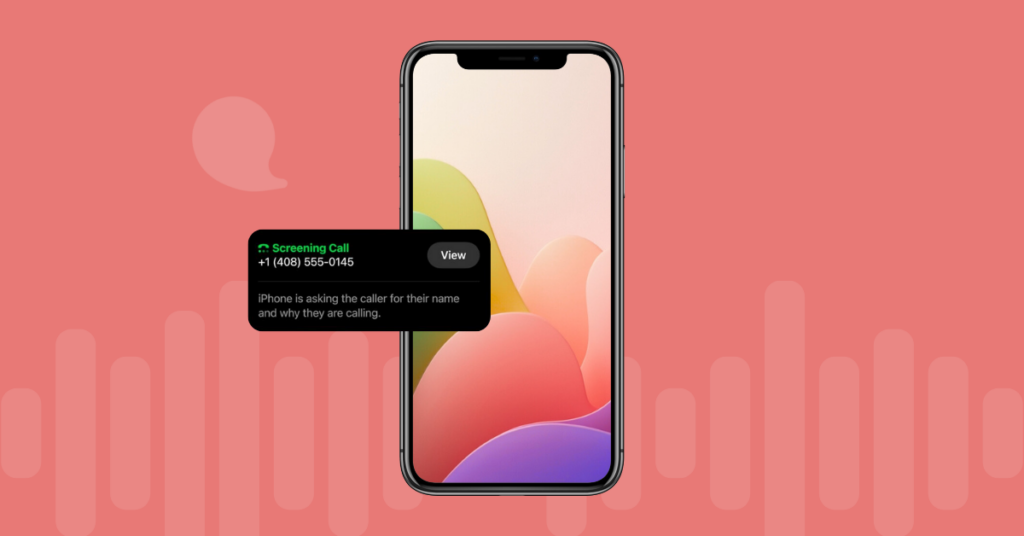
On iOS, features such as Live Voicemail and Silence Unknown Callers allow users to screen unfamiliar numbers. Calls from unknown callers may go straight to voicemail, where the recipient reads a live transcript before deciding whether to engage.
On both Android and iOS, Call Screen and similar features can:
- Ask the caller to state their purpose
- Transcribe the response in real time
- Allow the recipient to answer, reject, or call back later
In both cases, the first “conversation” is not with a human. It is with an AI assistant acting as a gatekeeper.
Practical ways to get past the gatekeeper
Use stable, recognisable numbers
Repeated use of the same number increases familiarity and trust.
Leave clear, human voicemail messages
Short or vague messages are often ignored. Clear identification, purpose, and value matter.
Avoid aggressive retry behaviour
Multiple missed calls in a short window almost guarantee blocking.
Give recipients a reason to call you back
A specific, relevant reason performs far better than “just following up”.
The goal is not to bypass screening systems, but to behave in a way that earns a second chance.
Why number type matters more than many teams realise
The type of number you use for outbound calling has a significant impact on trust, screening behaviour, and long-term deliverability.
In many markets, mobile numbers are legally treated as personal data because they are closely associated with individuals. That does not prohibit business use, but it does increase compliance obligations around consent, privacy, and data handling.
Mobile number ranges are also heavily represented in scam and peer-to-peer calling. As a result, carriers and device-level spam filters tend to treat traffic from mobile numbers as higher risk by default. This makes mobile-originated business calls more likely to be screened, labelled, or blocked after relatively modest volumes.
By contrast, national, geographic, and toll-free numbers are often explicitly allocated in numbering plans to signal organisational use. They tend to:
- Be easier for networks and devices to classify correctly
- Build reputation more predictably over time
- Appear more trustworthy to recipients through search results
- Generate higher callback rates once recipients verify the caller
Some numbering authorities have also moved to clarify that mobile ranges should primarily indicate mobile devices, reinforcing the idea that business voice identity is better communicated using number types designed for that purpose.
For regular outbound calling, number choice should not be treated lightly. Moreover, it is part of responsible traffic design.
Outbound still matters, but it works best when it creates inbound
Pure cold outbound is becoming harder. That does not mean outbound loses value. It means its role is changing.
The most effective teams increasingly use outbound activity to:
- Create awareness
- Establish familiarity
- Prompt inbound responses later
Examples include:
Pitch useful content
Referencing genuinely useful content instead of leading with a cold pitch.
Engage online first
Using outbound calls to follow up on prior digital engagement.
Be flexible
Encouraging prospects to call back at a time that suits them.
When someone chooses to call you, many of the filters disappear. Inbound calls carry higher trust, stronger engagement, and fewer delivery barriers.
Outbound works best when it supports that outcome.
The role of responsible service providers
Successful outbound calling today is controlled, measured, and predictable.
Key principles include:
- Gradual volume ramp-up
- Dialling aligned with agent availability
- Active monitoring of SDC ratios
- Thoughtful number usage
- Respectful timing and cadence
- Continuous target list hygiene
Outbound calling succeeds when it looks intentional, not opportunistic.
How to run outbound campaigns that get answered
Modern VoIP providers are no longer neutral pipes. They actively monitor traffic patterns to protect network quality and call deliverability, often enforced by regulators.
This helps ensure that legitimate business calls continue to reach real people, not spam filters.
A note on responsible network use
At VoIPstudio, we monitor outbound traffic patterns across our network to help protect call quality and deliverability. When we see elevated Short Duration Call ratios or behaviour that could harm reputation, we work with customers early to adjust dialling strategies and avoid penalties or blocking that may be applied for prolific SDC activity.
A quick outbound readiness check
Before launching an outbound campaign, ask:
- Is call volume ramped gradually?
- Are dialling rules aligned with agent availability?
- Are SDC rates actively monitored?
- Are numbers used consistently and appropriately?
- Is list quality verified and current?
- Does outbound activity support inbound response?
If any of these are unclear, deliverability risk is already higher than necessary.
Final thought
Outbound calling is still a powerful tool, but it now operates in a world shaped by filters, algorithms, and AI assistants that never sleep and never assume good intent. Zero-trust policies can apply to almost any IT or communications system, and telecoms operators globally are helping customers take advantage of this level of protection today.
The businesses that will succeed with voice communications are not necessarily the loudest or the fastest. They are the most predictable, thoughtful, respectful, and deliberate.
In a spam-filled world, being easier to trust is what gets calls answered.
More from the blog

Want to improve your business communication?
Unlock enterprise-class call center power at affordable prices – no hardware, no delays, no surprises!