Table of contents
Customers have high expectations these days. They’ve got used to automation, and they know what AI tools can do, so they expect businesses to use this technology extremely well.
That expectation comes with a cost if it’s not met. According to Zendesk, 60% of consumers say they buy from a brand based purely on the service they expect to receive. And the tolerance for a bad experience is thin: 73% will switch to a competitor after multiple bad experiences, and more than half will leave after just one.
What it takes to meet customer expectations today
We asked business owners how much of their support runs on AI versus customer agents, and what matters most when a bot fails and a customer calls in. Here’s what they told us…

Head of Growth at truck1.eu
AI filters out around 35% of top-of-funnel queries
But once a prospect is seriously considering a heavy machinery purchase, they need a human for the details. Prospects request to speak with a person by phone when they have specific questions about technical inspection reports, need to clarify any attachment or equipment details, want to get specific instructions regarding cross-border delivery, or are looking to exchange contact information with the seller directly.

CEO at Geniusee
Only 35% of customer queries can be handled without a human
Straightforward, low-risk, tier 1 type stuff like account access and basic troubleshooting. The other 65% need a human agent.

Partner Success Manager at Best California Movers
We limit the use of bots.
We limit the use of bots handling all stages of communication to 20%, such as booking confirmation or address verification. The remaining 80% of interactions are handled by human operators because it is essential to have a human touch when transporting your belongings and adhering to strict time limits.
The pattern holds across nearly every business we heard from.
The more routine or low-stakes the request, the more comfortable companies are letting AI own it. The more emotional, high-value, or irreversible the outcome, the faster it goes to a human agent.
Matching high customer expectations usually comes down to having a reliable cloud phone system in place to bridge the gap between automated flows and human agents.
Where bot handoffs go wrong
We’ve all been there. You’re stuck in a bot loop, typing the same question a slightly different way each time, hoping the next attempt finally gets you somewhere. Eventually you ask for a human representative, and get bounced into a queue.
Pratik Singh Raguwanshi manages digital experience for BPO operations in telecom and healthcare at CXrove, and he points out why this moment matters so much.

Manager, Digital Experience at at CXrove
The real problem is the AI-to-human handoff...
The most important aspect is not the failure of AI to solve a problem, but the associated disruption involved in transferring from AI to human support. By the time the customer decides to call, they have generally tried self-help options and are frustrated and confused.
As AI takes on more of the easy interactions, the calls left for humans skew harder, and customers who already talked to a bot expect the agent to know what that conversation was about.
Examples of what can go wrong
A few things reliably turn a bad bot experience into a worse one, and business owners were blunt about what they’ve seen go wrong.

Founder of DeepAI
Losing context came up in nearly every response we collected
It is important for the transfer (of data from the bot to the consultant) to be complete and, if this leaves out the information already known to the bot, you end up with two failures instead of one.

Managing Attorney at Douglas R. Beam, P.A.
An easy path to a human agent is critical in our industry
We work with clients who are often already in distressing time of their lives. And if they have to speak to a chatbot for an extended period of time, then they may get frustrated or even more stressed. So, we're careful about not adding another barrier.

COO of LINQ Kitchen
Landing with someone who has zero context undoes whatever the bot got right
Real time display of a screen with all relevant data from previous conversations with the client, including but not limited to the 3D model the client viewed prior to contacting us via phone and the client's cart items. This allows our representatives to enter the conversation already informed about the exact problems and solutions that will satisfy the client's needs and build confidence in our company.
A clunky handoff isn’t a minor annoyance. It’s often the moment that decides whether someone stays a customer or not.
How to make a handoff work
Fixing this handoff gap usually comes down to how a company configures its phone system.
Context passed through automatically was, by far, the most-mentioned feature across every business we talked to.
Taras Tymoshchuk called it context sync, or a screen pop: “Your phone system needs to immediately show the agent the chat history and intent of the caller. Nothing creates more friction than forcing a customer to retell what they just said in a chat window.”
Jennifer Claytor wants something similar tied to their CRM: “The main requirement to our phone system when our bot has to escalate a call to a human is to be able to pop up a relevant CRM ticket showing the address, scope of services, and the problem described by the user immediately after the call is picked up by our dispatcher.”
Setting up a direct VoIP CRM integration makes this automatic, giving agents the caller’s full profile on screen the second the call connects.
Smart routing based on intent is the other feature that came up again and again.
Yauhen Krutsko described their approach at truck1.eu: “This feature allows our telephony system to identify the caller’s identity using their Caller ID, cross-reference that data with their account and browsing session information on Truck1, and then route the call to the first available customer service agent. The agent can then immediately access the relevant vehicle listing and technical documents.”
Marc Dal Cin, a licensed electrician and founder of Calibre Connect, does something similar based on issue type: “I set up call routing by type of issue. That way urgent service calls are sent to a special line and are not loaded on the regular line behind billing calls. I set this up based on keywords the bot flags during triage.”
Call recording and searchable transcripts round it out.
Marc flagged this as the last piece of the puzzle: “Each failed handoff leaves a record and I use these recordings to ensure that I know exactly where it went wrong so I can tighten the script.”
None of this is about making AI look bad. AI genuinely earns its place handling the volume of simple, repetitive requests that used to eat up a support team’s day. The complaint business owners raised again and again wasn’t with automation itself, it was with what happens the moment automation reaches its limit and nothing’s in place to catch the handoff.
Upgrading your setup to an AI-powered phone system gives agents real-time transcripts and post-call summaries, turning tricky transfers into successful customer calls.





What this means for your phone system
The big takeaway here is simple: a chatbot can only do so much. Your phone system has to be ready to pick up right where the bot leaves off.
A few capabilities make the difference between a phone system that just takes calls and one that actually supports a hybrid AI-human model:
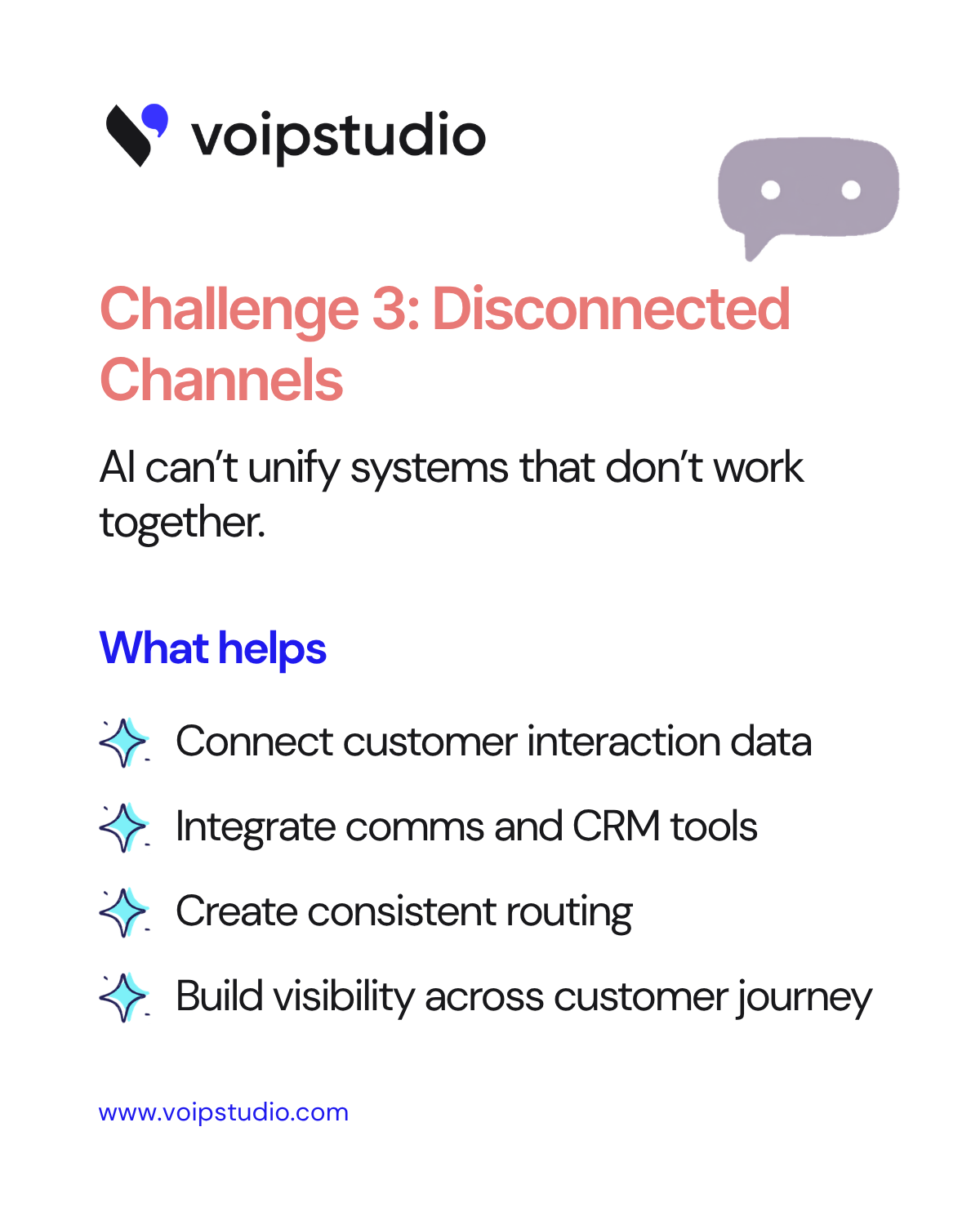
- Automated Context Sync: Displays chat transcripts, ticket details, and account history the second a call connects, so callers never have to repeat themselves.
- Intelligent Skill-Based Routing: Directs calls by urgency, issue type, or customer value, not by which menu option someone guessed correctly.
- Native CRM Integration: Brings up the customer’s full history on-screen instantly, removing the need to jump between tabs.
- Transcripts & Searchable Notes: Records and transcribes calls automatically, making it easy to spot where a transfer broke down.
AI-Assisted Call - Summaries: Generates post-call notes and action items on the spot so critical follow-ups don’t fall through the cracks.
Automated tools handle basic tasks, but your phone setup decides what happens when a customer needs real help. Syncing chat logs, customer history, and call summaries to your live agents prevents bad handoffs before they happen.
Dariia Panchenko
More from the blog
Want to improve your business communication?
Unlock enterprise-class call center power at affordable prices – no hardware, no delays, no surprises!